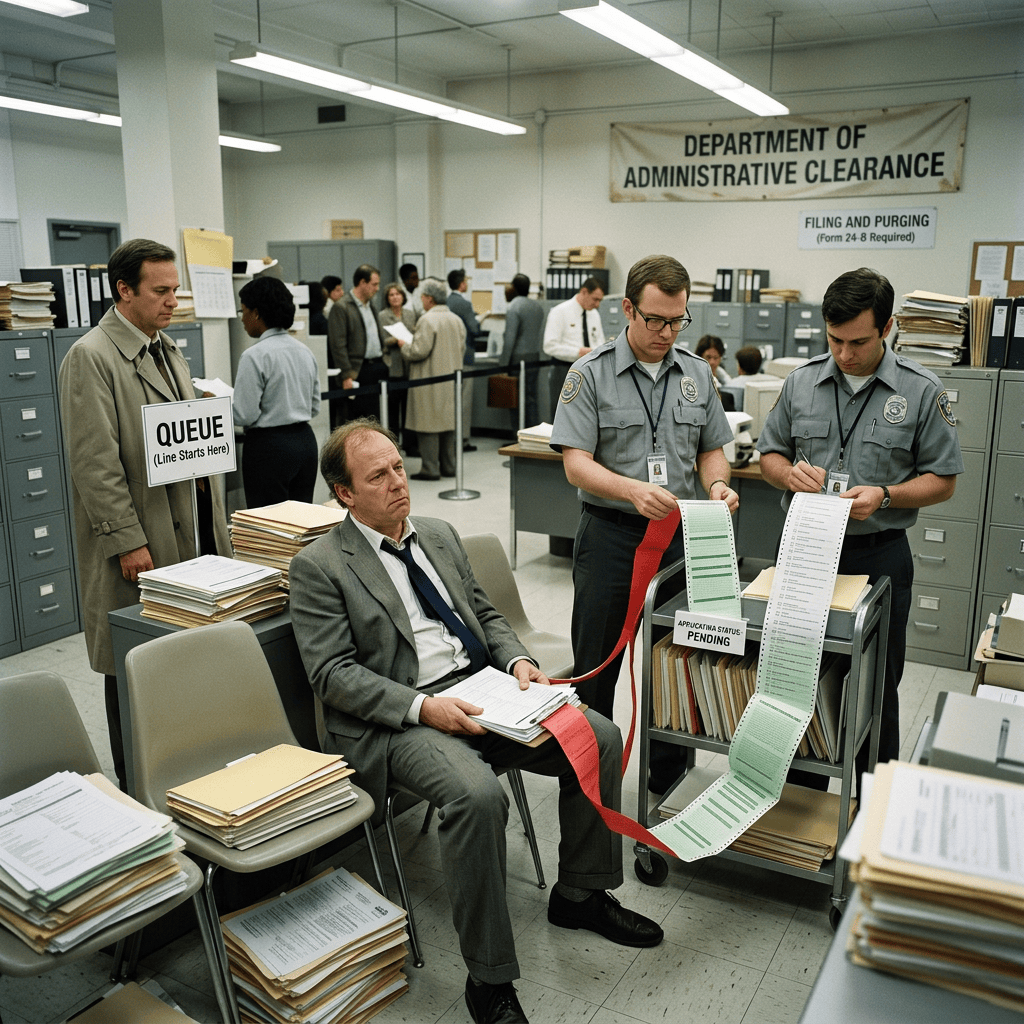
I was handed another file of bureaucratic bullshit the other day.
Well, I’m torn between bullshit and gold. On the one hand, the contents are complete shit. On the other, it’s more grave-digging gold. I would have thought Damage Control 101 said to sit down and get your story straight first. Apparently not. Apparently damage control means typing whatever thought bubble pops into your head, covering it in pathologising, paternalistic jargon, wrapping it up in ‘responses’ and ‘summaries’, and voilà, you’ve got your next episode of Utopia. The left hand doesn’t know what the right hand is doing. In the middle is an autistic client who’s spent the past six weeks doing a precision-level autopsy of everything they’ve ever done.
Two days in a row, I got documents that contradict the contemporaneous records I’ve kept. They also contradict each other. I genuinely don’t know whether they thought I was too stupid to notice, or they were. One says my therapist kept consistent and predictable boundaries. The other tries to redefine boundaries as something other than what everyone understands therapeutic boundaries to mean. Then there’s the data, which shows boundaries that weren’t consistent or predictable, and a pattern of intermittent reinforcement.
Another clinician said to me today, ‘God, I hope you never do this to me.’ The thing is, I don’t have the data to do it to them. That’s what should have been a red flag long ago. I kept meticulous records with my former therapist because I never felt at ease. There was always something I couldn’t quite name, a persistent unease that probably explains the constant rupture-repair cycle we were stuck in. It felt like an abusive relationship. With hindsight, I understand why.
The document I got yesterday even put my emailing down as a contributor to my clinician’s burnout, as if I was responsible for her wellbeing and not the other way around. It’s not the first time I’ve run into that kind of role reversal with her. It was practically built into the relationship. Whenever I raised something she’d said or done that hurt me, the axis tilted. If I told her something had activated my mother wound, her reflex was often to fall back on the technicality: ‘Remember, I’m not your mother.’
As I tried to explain to her: imagine falling out of a tree and breaking your arm. Later, someone accidentally knocks that broken arm and says, ‘Remember, I’m not the tree.’ They’re right. They’re not the tree, but the arm still hurts when it’s knocked. I’m not confusing the two. An old wound has been hit, and reminding me where it came from doesn’t stop it hurting. What helps is a clinician who’ll look at the injury with you, instead of using a technicality to duck out of the room.
When I pointed out a harm in an email, I’d usually get an unreserved apology that never seemed to come with accountability, followed swiftly by a gentle reminder of how much she cared, how hard she was trying, and how much my lack of trust had hurt her.
Suddenly the client who’d been hurt by a blurred boundary was comforting the clinician, reassuring her she was a good person, and managing the fallout. When your therapist writes to you about feeling ‘devastated’, bringing her own hurt into it while holding all the institutional power, you’re not doing therapy anymore. You’re managing her emotional wellbeing.
Then she did it again in the treatment summary, as though I was supposed to put my regulatory complaints on hold and work through her emotional exhaustion.
After three years of that, the final document of my treatment includes a section on her own stress and the toll my distress took on her. Same pattern: the clinician’s hurt at the centre, while the client sits in the wreckage of iatrogenic harm.
She spent pages on how hard it was to manage a ‘complex’ client like me, as if her job in the room was to be protected from my reactions rather than to hold the container for them. Even at the end, writing a document meant to summarise my treatment and support my safety, it became about how much she’d suffered.
When accountability knocks, out comes the violin.
The audit has started. By all accounts, regulators don’t give a fuck about Yorkshire tea.


Leave a Reply